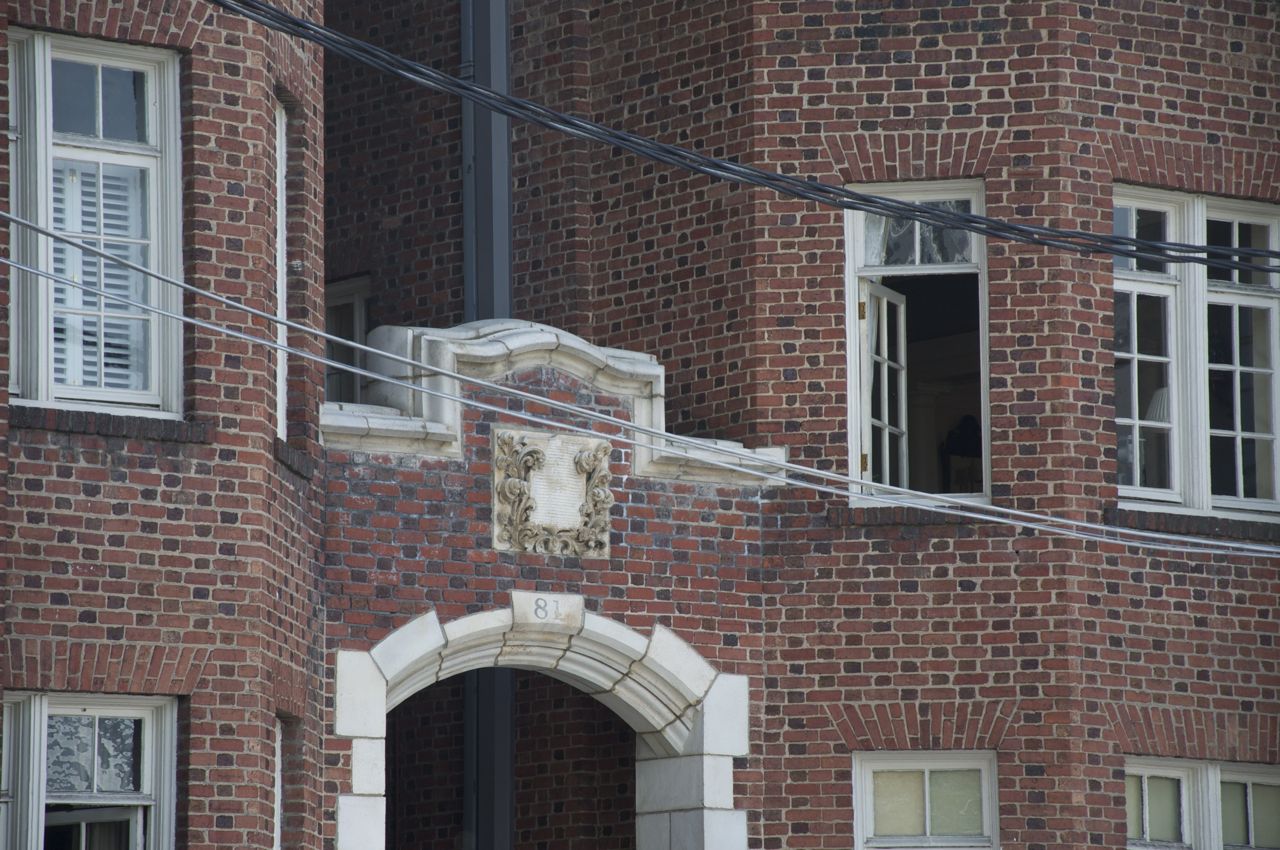
Walnut Room this way

Walnut Room this way
Rio.

Sunday, April 22, 2012

Next stop: Duncan

With the completion of the railroad from Memphis to New Orleans in 1884, it opened up the Delta for travel other than via the Mississippi River.  James Brown obtained land patents west of Duncan in 1853 and Newman Dobbs obtained patents at the site of present day Duncan in 1855.  After the railroad was built, people began coming to the town.  A grandson of Brown's built his house near the railroad.


 The first Post Office was established in 1885 and the community was named for Robert P. Duncan, a Memphis attorney who bought a plantation from Brown's son.  In 1929, a tornado destroyed much of the town.


Thursday, April 19, 2012

Butch Mudbone

This is Butch Mudbone, the Itinerant Bluesman. 

We went over to the Delta Furniture Store stage to get seats for the 3 p.m. Adam Gussow show, and Mudbone was playing.  I had never heard of him, but turns out I liked his music.  What I love about this festival is you can stop and listen to a whole show, or just wander the blocks, hearing the snippets of shows from one end of the block to the other.

Next up, Adam Gussow, and with video, Frank!

Tuesday, April 17, 2012

Low Society, straight from New York City

Note: For the historic preservation people, see my post on the Greyhound Bus Terminal in Clarksdale (circa 1936) over at Preservation in Mississippi.

 At the Juke Joint Festival in Clarksdale each April, the variety of music can be fairly outstanding.  In addition to your traditional blues folks, there are always the not so southern versions.
 Low Society features the vocals of Mandy Lemons, who was just a little scary in places.  She is what some might call "spunky" or even "spunky funky" if there is such a thing.  The bio at reverberation describes her:
...astonishing powerhouse voice which mixes southern fried soul and northern attitude...
As my hip students would say, "Oh yeah, she got some attitude."  Here she is singing her song Long Black Limosine,which is some story about getting drunk.  Go figure, whoever in blues/country blues/rock and roll blues ever sings about getting drunk.

 Looking like a cross between Abby Sciuto on NCIS and Lady Gaga (albeit considerably fluffier than either of them), she was bouncing all over the stage, varying her screaming and head-banging with a soulfully tortured look.
 I could never decide if those were bullets on her belt or some punk rendition of Spike's dog collar; none the less, she made quite a colorful break from the typical Juke performer.


 Cuz, however, was quite annoyed with half of Low Society.  "I wish she would stop screaming so I could hear him playing--he's quite good."


While I won't be rushing out to buy their music, I still enjoyed it.  Sometimes it is about the music, and sometimes it is about the performance: "the whole package" as the judges on American Idol would say.  Still, I'm pretty sure Simon would have dissed her.

Sunday, April 15, 2012

Juke Joint Festival 2012: Clarksdale

Clarksdale is home to the blues every weekend of every year, but it comes alive during the Juke Joint Festival each year in April.  My cousin drove up from New Orleans for me to take her over.  I have decided she is now my favorite road trip companion.  She loves to stop for pictures, and we went way out of our way several times to get back around to photograph a building or some unique detail of the building.  We both agree our pet peeve is being with someone who won't stop for a photo, or who gets cranky if you get lost or take the circuitous route rather than a straight line.

Apparently, this drug store sign has been photographed many times, including by our own Preservation in Mississippi's EL Malvaney.  Perhaps Malvaney can also fill us in on the Masonic Temple, since wading through pages of data yield less than the cornerstone in terms of history.  A peek through the window shows that something is still happening in the Haggard drug store, though it seemed more empty shelves than those with merchandise.  The drug store occupies the corner of the building.

 We contemplated the idea of buying the building, and setting up our weekend getaways locale in the historic downtown Clarkdale.  I imagine if I think I have a lot of work on my hands trying to salvage my little Taylor hillside ranch, that taking on this 1923 building might be more than I can manage.

However, we would be just across the street from the historic Greyhound Bus Terminal, and ready to roll if they ever decide to start interstate travel again.  Our being in the station reminded me of our trip via Greyhound to Denton, Texas back in 1968, and an unplanned stop in downtown Dallas.  There we were, two West Texas girls dragging our suitcase through downtown Dallas looking like a couple of rubes carrying our pillows and blankets.  When we decided to "go Greyhound" they didn't tell us Greyhound wouldn't be making the left turn in Dallas to get to Denton, and we did not discover until we go to the Dallas station that we had to change busses...and bus stations.  The Continental Trailways station is where...and which direction is that...and it's how many blocks?  Let me just say right now that the trip was not worth the effort and I am pretty sure this was the beginning of the end for me and my high school boyfriend...

Saturday, April 7, 2012

Flemish Bond brickwork: And Bond, more Bond

 I love the excitement of learning something new about architecture as I get deeper into this hobby (or possibly rapidly becoming an obsession!).  Preservation in Mississippi has a new series, the Architectural Word of the Week.  Recently, it was Flemish Bond.  I knew it looked hauntingly familiar, and after due diligence, I located this example from a building I spotted in Atlanta last fall.
 At the time, I had no idea what it was called, just that I liked the uniqueness of the brickwork.  Flemish Bond is a type of brickwork where every other brick is a stretcher and every other brick is a header.  You can see the darker bricks are placed as headers, and the lighter bricks as stretchers.
 Then, it spiraled out of control and I began searching all my photos of buildings, seeking examples of Flemish bond.  This one is from the Water Valley courthouse in Yalobusha County.  Not all of the rows exemplify the Flemish bond technique, just some of them, so I don't know if that actually qualifies it as Flemish bond, or if it has some other name.  The example is in the 4th row above the gray brick trim on the window.
Another variation is called Common Bond, or American Bond, or English Garden Wall (Acadia University).  It is a row of headers replacing every nth course of bricks, where n is usually odd.  The headers are centered over headers in the rows of headers below.  This example is from a house in Mound Bayou.

 Also from Mound Bayou, this church illustrates Common bond.  
 From the side of a building in New Albany, note the row of headers in the pale green section mid page.
 This example is from the old Masonic Lodge building in New Albany.
 This example is the Graham, Texas old post office, a WPA building.
Heading back to Mound Bayou, again, the Bank of Mound Bayou building demonstrates Monk Bond and Common Bond.  There are rows of headers every 7 courses.  Monk bond is two stretchers between headers.   Here, it appears to be a variation in that there are more than two stretchers between the headers, so I don't know if that earns it a new name, or if there can be variations on the number of stretchers in between the headers.  This can be seen in the course that is almost in line with the door handle, and also in the row with the orange brick to the right of the door, about half way up the photo.

I finally had to call a halt, after as usual spending way too much time on this.  It is amazing all the little details that you miss if you don't know to look for them.  I imagine that bond design will be on my list to watch for from now on.  Thanks, Preservation in Mississippi!

Friday, April 6, 2012

Old Houses on Canal Street in Natchez

 Searching through the HABS files in Natchez, I ran across this photo of Canal Street houses taken in 2006 by James W. Rosenthal.  I was first intrigued by this section of Natchez in my first visit about the same time.
 I don't know if those exact houses are still standing, but these at the end of Canal have been boarded up since my last visit there in 2010.
There are two twins side-by-side on Franklin street, both empty.  


Sunday, April 1, 2012

Old Wesson Public School: One of the 101 Mississippi places to see

After finishing up in Fayette, I headed on the back roads over to Wesson to locate the old school building.  I had intended to find the Poplar Hill School near Fayette, but my lack of clear directions did not bode well for the navigation system and I was spending way too much time with a 5 hour drive ahead of me.  In fact, I almost just kept going to Jackson once I reached the Interstate, but as I was this close, I forced myself to just chill out and make the trip on to Wesson.
 The building is currently under renovation and will house the St. Ambrose Leadership College--a residential college honors program that will offer 20-30 scholarships to the most outstanding male graduates in Mississippi (Mississippi Heritage Trust; Preservation in Mississippi).
 The school was first erected in 1889, destroyed by fire in 1890, and rebuilt in 1893.  It is in the same Romanesque style as the old Mississippi Mills and it is speculated that they both may have been designed by the same architect (MDAH, Mississippi Heritage Trust).  It is one of three remaining public buildings associated with Wesson's development through its textile industry.
 Wesson was founded during the Civil War by Col. James Madison Wesson (MS GenWeb Project).  He built the Mississippi Manufacturing company to produce "quality cotton fabric."  The mills were sold in 1871 and renamed Mississippi Mills.  The mills installed light bulbs the year after Edison perfected the invention and passengers on the evening train enjoyed the "marvelous lights" as they passed through Wesson.  Wesson apparently holds the honor of being the first town in the area to have electricity.  The mills were dismantled and sold for scrap during World War I, after falling into receivership and finally closed.
 The details of the building are quite striking to me.  There was renovation work going on the day of my visit, which while interfering with my picture-taking, was interesting to see taking shape.


 I have always loved stairways and steps in about any form or fashion.  Check out this school photo taken on these steps in its early years!
Soon, students will be walking up those steps again, and walking through these rooms again.