Walnut Room this way

Walnut Room this way
Rio.

Saturday, August 30, 2014

Lexington Historic District: Holmes County Bank and other Lexington History

The Lexington courthouse square is laid out in the "Four-block square" plan as shown in Price, Edward T. "The Central Courthouse Square in the American County Seat." Common Places: Readings in American Vernacular Architecture. (Upton, Dell, and John Michael Vlach, eds. Athens, GA: University of Georgia Press), p. 125. This configuration has four streets bounding the square itself with four more streets bisecting the blocks and intersecting with the center portion of the square on all four sides the courthouse itself is placed on axis with the streets that are centered on the square. This creates rectangular, rather than square, city blocks with short sides facing the square and long sides leading away from the square. (Baughn, J. V. O., 2000, Nomination form for the National Register of Historic Places, "Lexington Historic District")
When I began this post, my intentions were solely on the architecture.  I had no intention of going to Lexington that day, it just happened to be between me and Greenwood, my destination.  However, when I drove into town and saw the courthouse looming in the distance, I knew I would be making a stop.
c.1900 former Holmes County Bank
The bank building dates to around 1900, but the Holmes County Bank only dates to 1932 according to the current website.  Morris Lewis immigrated to the US from Poland in 1882 when he was nine.  He moved to Lexington, Mississippi at the age of 17, and in 1896, organized the Lewis Grocery Company (The Delta Democrat-Times, 27 December 1957, p. 1).  He organized the Merchants and Farmers Bank and Trust Co. in Lexington, would became the Holmes County Bank and Trust Co.

The Holmes County Bank and Trust Co. was one of the targets of the civil rights activism in Mississippi.  Bea Jenkins of Lexington was the housekeeper for the president of the Holmes County Bank at that time (Tanzman, H. 2000. An oral history with Bea Jenkins. Civil Rights Documentation Project).  

I marched around that bank, too.  We did.  We marched around that, and someone there said, 'Bea, arent' you afraid to march around?' Said, "That's the man that you work for.'
And I told them it didn't make any difference because we wanted--I said, 'People, some blacks, have they money there, too.'  And they didn't have any black people working there as employees.  And I said, 'And I don't see any difference.  If he's not hiring any blacks, why not march against him, too?'  So, I did.  And go back into their home the next day and work.

Read the rest of the oral history with Bea Jenkins.
Lexington made history for another reason, too--taking on the tobacco industry

Tuesday, August 26, 2014

Holmes County Jail

Mississippi architects N. W. Overstreet and A. H. Town of Jackson designed this 1936 Art Moderne jail in Lexington.  A PWA project, it cost $24,528, and $10,000 of it was funded from the PWA.  Holmes County erected a new jail facility in 1999-2000.  What's in store for this building I wonder?  It is both historic (a designated Mississippi landmark) and stunning in the simple design.  Maybe I could just renovate it and move in, living in half, and operating my research facility in the other half.  I will have to study on that possibility.  I wonder what they would charge me for rent?

Sources: Mississippi Department of Archives and History, Historic Resources Inventory; Mississippi Landmarks; "New correctional facility will replace 63-year-old county jail" (June 3, 1999). Holmes County Herald, 41(22). p. 1.

Friday, August 22, 2014

Knowledge, Citizenship, Industry: It's Back to School

 A few weeks ago, I was over in New Albany to see a friend and she took me around to some of the historic school buildings in the area.  She recalled her mother saying something about a WPA gym built there during the depression, but we could not locate it.  The relief panel that was formerly on the front of the high school building has been moved to the back of this building, where it sits in the shadows.  The reliefs remind me somewhat of those at Senatobia High School--where they still proudly adorn the front of the building.
 Edgar L. Malvaney designed the New Albany High School in 1936.  Use of the concrete bas reliefs were common during the period, as the Great Depression necessitated the use of simpler, less expensive materials in building construction and ornamentation.
 Interesting way to illustrate citizenship?  The stern and austere judge seated above the citizens who essentially have no face or body?  Citizenship as obedience and subservience?  Because reliefs were often stylized, it may have just been a standard format, but I tend to see the symbolism in everything.  Our schools were one of the institutions used to socialize us to the roles of citizen, and it would have reflected the belief that obedience is one of the more important qualities in a citizen.  Of course, obedience to an immoral or unjust law is not a trait that I value, and citizenship should challenge those injustices and set them right again.  It is just that it is a hard thing to do.
 Bas relief can be designed by carving into the stone or wood, creating a raised appearance around the carved section, or precast from molds.  Molds to cast pieces required very simple designs or the concrete or other material could get caught in intricate designs that allowed the material to gather in an undercut and ruin the design (Relief in clay mold making and mold-making and casting, Vicki Lynn Wilson at Marylhurst College).
Still, it seems not fitting for the great pieces of art to be hidden at the back of a building, seen by few people.  In fact, we discovered them only accidentally.  My friend said she wanted to show me the "stones" from the old high school--I was expecting rocks!--but they were not in front of the middle school that occupies the site of the old school.  As we drove around the corner to turn around, she exclaimed "there they are!"  Hidden behind the arcade walkway, at the back of the building, in the shadows.  Maybe that is symbolic of what we have done with knowledge, citizenship, and industry.  Perhaps we only find these things, develop these abilities, and use these skills if we seek them in the unlikely places.

Sunday, August 17, 2014

Cleveland County Courthouse, Rison, Arkansas

 The Cleveland County courthouse, located in the county seat Rison, is the county's "most architecturally significant building (Cleveland County Courthouse, Arkansas Historic Preservation Program).  It was constructed in 1911 for $65,000.
 Built in the Classical Revival/Modern Renassance styles by Theodore M. Sanders, architect, and Monk & Ritchie, Contractors, the building  showcases
...brick quoins, denticulated cornices, Tuscan pillars, and limestone keystones on first floor windows...(Arkansas Historic Preservation Program)
 The clock tower rises 20 feet above the roofline from where it sits on an octagonal dome.  It has four clock faces, and is "surrounded by Tuscan pilasters" which are also featured on the front of the central core of the building (Groshong, D., 2012, Cleveland County Courthouse, Encyclopedia of Arkansas History and Culture).

The courthouse retains much of its historic interior, including ceramic tile and pressed tin ceilings.

Friday, August 15, 2014

Wortham Gymnasium in Oak Grove, Arkansas

Oak Grove is a small African American community about 2 miles from Rosston, in Nevada County, Arkansas.  It has quite the history of significance in education for African Americans in Arkansas.
Few, if any, agencies of the New Deal directly affected as many African Americans during the Great Depression as did the WPA. (Gatewood, 2000, p. 126)
Arkansas benefitted, as did African American communities across the United States, with the appointment of Alfred Edgar Smith from Hot Springs, Arkansas as a member of President Roosevelt's so-called "black cabinet" (Gatewood).  Mr. Smith served as assistant and advisor to Harry Hopkins, with a particular focus to advise about the needs and concerns of African Americans in the deep South.  Being from Hot Springs gave Mr. Smith in depth knowledge of the needs of his home state, and a number of educational facilities were constructed across Arkansas--many which still stand and are in use today.
In addition to the large gymnasium, the cafeteria/home economics building remains.  Both were constructed with funds and labor from the Works Progress Administration.  I would not have known the purpose of the home ec building had not a couple who lived across the street come out to visit with me.  While she was not from the community, he had lived there his entire--though young--life and gone to school in the buildings.  One building from the three-building complex constructed with WPA funds has been demolished.
Architectural classification of the concrete foundation, wood/weatherboard walls and asphalt roof was "Late 19th/Early 20th Century American Movements/Craftsman (Story, 1990). 
...tall, single story, wood frame gymnasium...designed in the broad, massive style common to the Works Progress Administration (WPA) commissions of this type and size...locally significant example of a simple but handsomely balanced design which reveals the skill of the Works Progress Administration workers.  (Story, 1990)
Two side sheds flanked the court area, and a stage was at the opposite end from the ticket booth in the entrance.  In 1990, the building and its interior were almost completely intact, and contained the original bleachers, columns, interior strip sheathing, stairwells, and ticket window, all "preserved and in good condition" (Story).

Sadly, that is no longer the case.  The roof collapsed at some point since 1990, and the interior is now significantly damaged.  Additionally, people have stolen items and artifacts from the building according to the couple across the street.  He stated the building had a historic plaque, and one day some folks from Texas stopped and removed it from the wall as a "souvenir."
 A high school building was erected in 1925 with help from the Julius Rosenwald fund.  The principal from 1932-1935, Mr. Vines, received a grant to use WPA labor to construct the home economics building.  When the Rosenwald school burned shortly after, Mr. Vines "persuaded the WPA to build a new administration/classroom building instead, and by 1935, to also building the home economics building (Story).
In 1935, L. W. Johnson became principal, and expanded the curriculum to include 12 grades.
It was at this time also that Johnson himself became aware that there was no gymnasium building locally which was available to blacks...Once again, with the aid of WPA labor, Johnson worked with county superintendent Basil Munn to obtain a new gymnasium for the students of the Oak Grove School District.
The building which resulted was not only a large and impressive structure; at the time, it was only the second gymnasium for blacks in the state of Arkansas and it was the largest gymnasium in the state...the Wortham Gymnasium...stood then as it does now for the endurance, hard work, and vision of the blacks in this area who dreamed on an independent opportunity to educate their own. (Story)
A professional basketball team--archrivals of the Harlem Globetrotters--played the A. M. & N. team from Pine Bluff.  The New York Renaissance Big Five, or the RENS as they were known, played the team in the Oak Grove gymnasium rather than in the college gym in Pine Bluff (Gatewood).
Construction of the gym began in 1938 and was completed by 1939.  It was named in honor of Roger Q. Wortham, Nevada County Judge from 1929-1935, and a supporter of Oak Grove's educational program (Smith & Joshua, 2003). While it was second in the state, it was the first high school gymnasium for black students in Arkansas.

The WPA granted $8,954 for the gym construction and the school district provided $3,680.  Local resident C. C. Bazzelle provided a portion of the lumber for the gym from his stand of "school trees" (Gatewood, p. 128).

The Oak Grove Civic League received a $10,000 preservation grant in 1998 to restore the gym.  It is unknown as to why the project was discontinued, and the League has been discontinued since at least the early part of the 2000s.
 
Sources:  Gatewood, W. B. (2000). Wortham Gymnasium.  In M. K. Christ and C. H. Slater (eds) Sentinels of History: Reflections on Arkansas Properties on the National Register of Historic Places.  Fayetteville, AR: University of Arkansas Press.

Smith, C. C., & Joshua, L. W. (2003). Educating the masses: The unfolding history of black school administrators in Arkansas 1900-2000. Fayetteville, AR: University of Arkansas Press.

Story, K. (1990). Nomination form for Wortham Gymnasium for the National Register of Historic Places.  Retrieved from Arkansas Historic Preservation Project.

Tuesday, August 12, 2014

On selfies, cleaning out the water trough, thunderstorms, repairing leaks, and new water troughs

Yes, it's been really busy the last couple of days!  I extended my stay two more days as there were still a few things Sis and I had not gotten accomplished yet.  Our evening caregiver is gone, and with a night shift vacancy, it means double time, so an extra pair of hands is helpful.  Not to mention that Sis and I have a lot of fun together and it helps to share the workload.

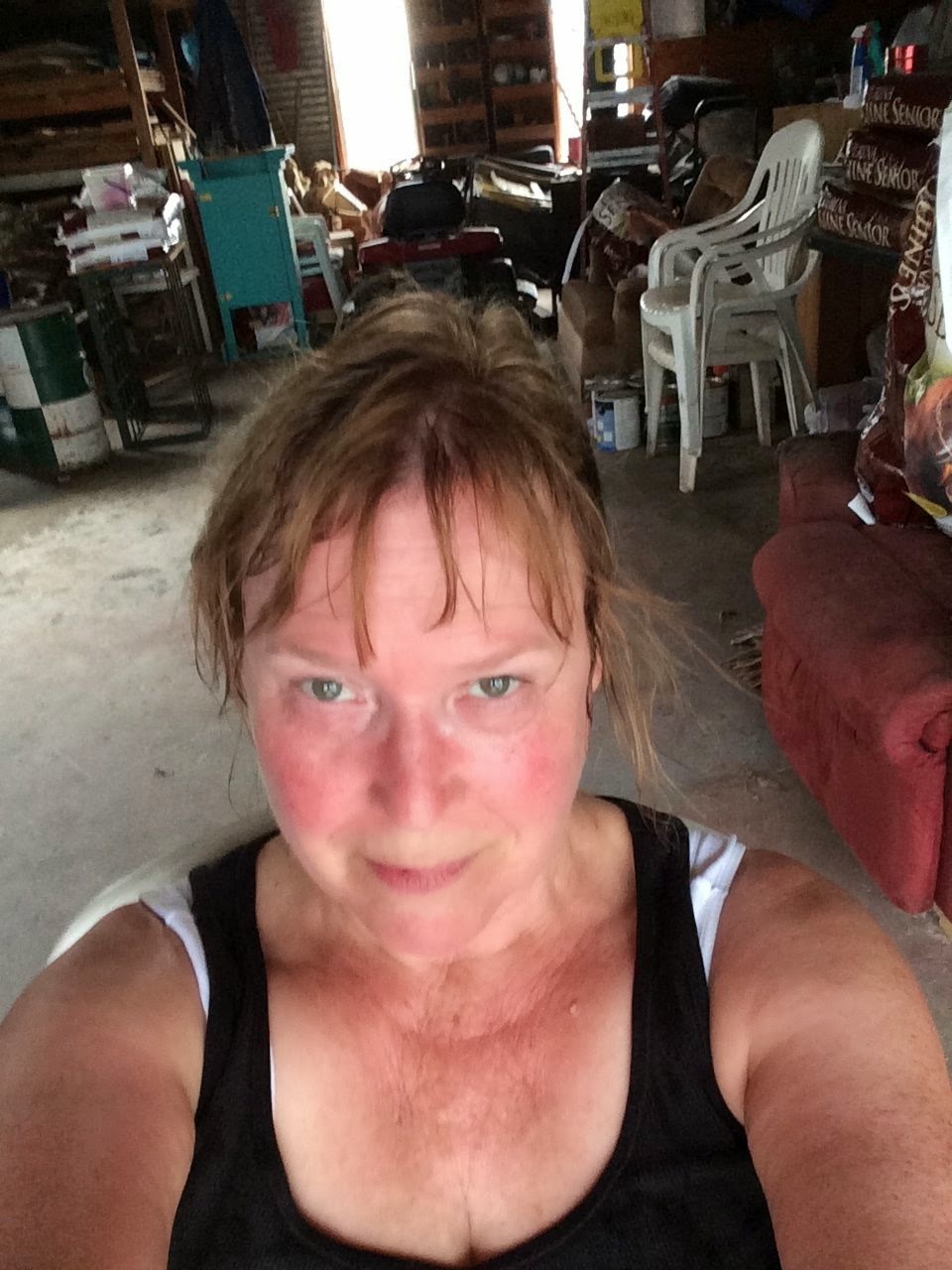
 So, about those selfies: I saw a tee-shirt yesterday that said "Selfies: Because no one else wants to take your picture."  I had to laugh.  I mean, really, has the selfie craze not gone completely wild?  Sure, folks have always taken self-portraits, but it used to be a lot harder, and therefore, less ubiquitous.
So, here I am competing with J Lo's posting last night of herself sans makeup and hair in a pony tail.  Except I had been cleaning out a horse trough, and then it started raining on me.  Sunday afternoon, when I thought I was leaving for home Monday morning, I finally forced myself to get out there and start bailing water and scrub the water trough.  It ain't easy.
 Just as I was finishing up and starting to refill the water, the clouds that had been building actually delivered, and it began to rain.  I stood in it.  I pulled up a chair and sat in the shop with the overhead door open, watching it pour, listening to the sound of music--the rain hitting the tin roof.  I went outside again and stood in it.  I walked up to the house in it.  I went to the back bedroom and sat on the bed, watching it rain through the screen door, listening to the sound of it hitting the tin roof of the carport.  It thundered, and rained, and rained and thundered.  Joyous!
 I decided late Sunday, about bedtime, to stay over.  Among the things that needed doing was repairing a leak in the shower faucet, and one in the outside faucet.  The plumber came out yesterday, looked at it and said, "Man, I hate to start messing with that."  I understand, as does anyone who lives in an old house with metal pipes.  You fix one spot, you are likely to cause a problem somewhere else.  Fittings get corroded.  That is why this faucet has a second faucet underneath.  When I was here last summer, the top faucet was turned on, and left on, and the bottom faucet was used to turn the water on and off when needed.  It is a common fix.  Somehow, with all the caregivers coming and going, instructions got misunderstood, or forgotten, or not transferred.  At any rate, people had been using the top faucet to turn on and off...and it no longer could do that due to the internal fittings loosening.  The result was a pretty good sized leak when the water was turned on to fill the water trough, and a drip when it was off.  Not good in a drought.

I mentioned it to Sis and that we had to get that fixed now.  The plumber said to do what we had been doing a year ago: turn on the top faucet all the way, which opened things up and allowed enough water to flow through that it did not leak, and use the bottom faucet.  My grandma came out in me, and I came up with a way to ensure the caregivers--in the event of changes or forgetfulness--would not use that top faucet again.  Underneath my note that says not to do it, I taped the bottom half of a water bottle over the faucet, so you cannot use it unless you went to all the effort to take the plastic bottle off.  Just in case someone could not make the leap from "faucet has a bottle on top of it, taped to the pipe, I can't reach it so I must not be able to use it" I added the note inside a plastic bag and taped it up a bit more.  Cheesh--was no one raised in the country around here besides me?
 Meanwhile, Monday morning when I went out to feed, I came back in the house and told Sis that half of the water in the trough had leaked out overnight.  Also not a good thing in a drought.  Regular readers know that Dad made a water trough from an old cast iron bathtub.  He grew up during the Great Depression, and he continued to re-use and make-do all his life.  He plugged the drain with some kind of contraption, and it has worked fine since 1982, but something apparently came loose when I was cleaning it out Sunday, and it is impossible to repair without turning the tub over, which I cannot do even with help.  Sis and I decided it was high time to just get a water trough that was intended to be a water trough.  She had to go to Wichita Falls yesterday, and just stopped by to pick one up.
 This morning, we unloaded it from her SUV and set it up.  It has a real drain, with a securely attached plug, is fairly light when empty, and hopefully, will not permit algae to grow.  If so and it has to be cleaned, instead of bailing water out, we can just open the plug, let it drain, tip the trough, and then refill.  Heaven, I'm in horse water trough heaven.
We waited until Rio and Jenny went out to the pasture after they ate to do it, so I don't yet know how they like it.  I do know that it sure meets with my approval.

Sunday, August 10, 2014

Lynn's Bench

 After a week of doing things here at Mom and Dad's, Sis and I drove up to Elbert to the cemetery Friday morning.  She wanted me to see Lynn's headstone, which they finally were able to finish.  She and Lynn had talked about it and decided they wanted a bench.  Just behind the bench, the headstone with the white flowers on it is Mama and Papa--my maternal grandparents.  Jane and Lynn were very close to Mama and Papa due to their living on the coast at the same time for years.  Lynn said he wanted to be buried at Papa's feet.  It is a small country cemetery, and many of my maternal relatives are buried there.
I don't know who mows the cemetery, but they had not finished the most recent sections--though most of it is dead brown grass anyway.  August is the hottest and driest month generally, although we got a fair rain yesterday, and it is thundering and dark clouds at the moment, and raining all around us, and temperature has dropped and cooled down to a pleasant 95 at the moment, due to clouds and wind.

When I was a child, I was fascinated by the graves with the shells on them, though time and the elements have taken their toll on most of the ones in Elbert.  My great-grandmother's grave has them.  We wandered through the family plots, talking about the ones we remembered, the ones we didn't, but knew to whom they "belonged" and a couple of the names that I was unsure of the relationship.  Sis filled in the blanks on a couple of them, and I had to ask Mom about a couple when we got back to the house.  The family history is fascinating to me--both those I knew and those who came long before me.

We stopped off at the small grocery store in Newcastle on the way back for bread, eggs, an apple, and some cool drinks.We had decided on tuna salad sandwiches for lunch.  We were headed out to Sissy's house for me to help her with some housecleaning and chores.  She spends so much time over here at Mom and Dad's, or running errands for them or taking them somewhere, that she seldom has time to take care of her own house.

We cleaned house for Mom as the regular housekeeper was unable to do it on her usual day this week, and it was getting a little gnarly by today.  Now I am contemplating a nap, what with Rio fed and my nodding off over the computer.  Definitely a good plan before heading to the shower, though sis will be back to get me in a couple of hours as we have more errands to accomplish before the weekend is done!  Time to go home, in order to rest!