Walnut Room this way

Walnut Room this way
Rio.

Friday, December 31, 2010

Getting lost in Lafayette County

In spite of tomorrow being New Year's Day, it was almost 70 degrees here today.  I was feeling restless--road trip always cures the blues, so I headed off to the post office and then west.  I thought of driving up to College Hill, but said, "nah, I don't wanna do that AGAIN..."

I took a right toward Springhill, a place I have never been and always was "fixing" to check out when I had time.  It's always a sobering thing to me to drive the rural roads in Lafayette County.  It's kind of like the sharp contrasts between the wealth of Cape Town and the poverty of the townships surrounding it in South Africa.  Oxford boasts beautiful homes and buildings and the Square and the University of Mississippi and countless condo developments right next door to folks living in poverty.  Of course, there is usually either a fence or a screen of trees separating the view, but none the less, they are neighbors.

I did not really have a destination, and when I drive the county roads, just take a turn as the whim takes me.  I found a few churches, but a whole lot of poverty--the kind you know about, yet still surprises you.

Wood frame houses with sagging roofs and missing windows--were they occupied or not?  The only usual clue was a dog in the yard, a mailbox, or a light in a window.  There often was little difference between those that seemed to be vacant and abandoned, and those that seemed to house someone.  Most of the people I saw outside those homes were African Americans and either waved or looked as if asking, "What you doing out here?"  It reminded me of being in the townships of South Africa.  It was either  a warm welcome or deep suspicion.

I remember talking with one of the ICE officers while working on the coast after Hurricane Katrina.  We were sitting in the mess tent in Poplarville, and I mentioned something about my work in townships in South Africa.  He (who was African American) cautiously asked about tension and relationships between black and white South Africans.  For the most part, the only time white people went into the townships was to exploit them or kill them.  Of course there was tension.  He looked at me and said I surprised him.   

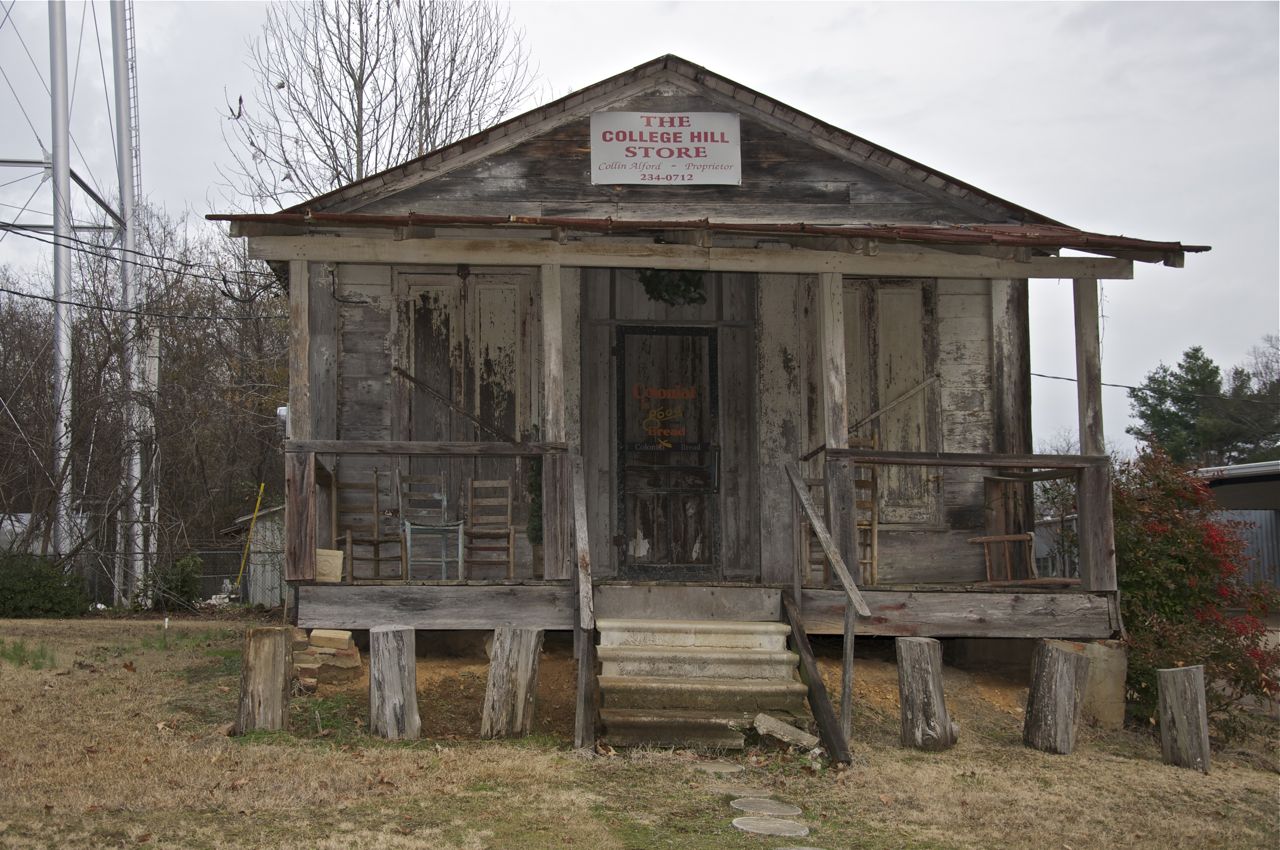
Finally, just about the point I decided I was totally lost and going to have to resort to the iPhone and Google maps to find my way out of where ever I happened to be, I saw a building that I knew I had seen before.  And then a water tower: College Hill.

I had to laugh; in spite of my not having wanted to go there, there I was.  It's kind of like a microcosm of my life at times: as soon as I say I do NOT want to do something, it's there on my doorstep, an unexpected and often undesired present from the universe. 


Monday, December 27, 2010

On keeping on keeping on


I was washing dishes just now when the postman honked twice.  (Yes, he really does always honk twice when he has a package to deliver).  I was surprised and delighted to see it was for me, and even more surprised and delighted to open it and find Si Kahn's new book.  First, a bit about Si, and then why it is so timely right now.  A big thank you to Jane/Gigi for thinking of me, and bringing back great memories.


Jane and I met Si at a NASW conference in Dallas, Texas.  We wanted to bring him to Abilene, and asked him how much it would cost.  He said, "You have to have a rich uncle."  Not daunted, we countered, "How rich does that uncle have to be?"  Turns out, not all that much.  We fundraised, collected sponsors, wrote a small grant, and voila! A few months later, picked him up at the Abilene airport.


Though the primary part of his weekend was spent at HSU doing workshops for students and area social workers, he took time to visit the newly created Abilene Peace & Justice Center, Jane and my recent  venture.  He also joined us with some other friends for a pot luck, and was such a gracious guest.


Si even good-naturedly put his handprint on the wall and signed it for us, after first asking, "Will the paint wash off?"  His handprint was the first, and many would follow during all the activities we held at the center.


We held our first Peace Camp that summer.  Somehow, the local newspaper got wind of it and wrote an article, which was followed by an editorial about "two local social workers quietly creating anti-violence training."

In the photo above, Jane's daughters Susan (back row, 3rd from left) and Bonnie (center, 3rd from left), and my son, J (front row, left) were part of our first crew.  You can also see how many more handprints were on the wall following Si's initiation of what became a tradition for every activity we held there.

As I was over in the Delta last Wednesday, I was setting up a meeting for January, for us to at long last get started on the community work there.  I don't know where we will end up--perhaps a little rabble-rousing, a little activism, or maybe just some quiet love of justice, but we will definitely be focusing on some creative community organizing.  I'll be doing my homework before next Monday, thanks to Jane.

Saturday, December 25, 2010

Here's ya white Christmas, Gigi

Yesterday was a perfect day of blue skies and no wind.  I was sitting outside at 4:30 watching the birds eat and the cats play, thinking what a great day it had been.  The air began to feel colder, and I watched a gray sheet of clouds start dropping down the sky line.  "Feels like snow; air smells like snow."  I finally got chilly enough to go inside.

When I opened the blinds this morning, an ethereal blue world was outside the window.
It's just a heavy dusting, rather like someone got heavy-handed with the powdered sugar canister while decorating the brownies and the pound cake.
Felix and Oscar are not quite sure what to make of it, though.
 It's dripping off the roof already, and melted off the sidewalk, so it won't last long.  In the meantime, it is the calmest, quietest, and most eerie shade of blue-white out there.  The cardinals are at the feeders, their red feathers making sharp contrast with the white snow.  I was glad (as were they) that I had the foresight to fill the feeders last night.


An original t-bag painted ornament from a women's co-op in South Africa.  Though they have a shop at the wharf, and even sell on-line now, I visited the workshop and the creator of the enterprise when they were still quite small and just getting started.  I hang the ornament in my window as I like being reminded daily of people who are working to bring employment, housing, education, and hope for a better future to those who were marginalized by apartheid.

While I have not been in the Christmas spirit for a number of years, I do love the smell of a Christmas tree and the wonderful feelings and memories it evokes of my childhood.  It's too much trouble with dogs and an allergic husband to actually have one, but this year, I made the compromise for a beautiful little rosemary tree.  The smell of rosemary is almost as good as juniper or fir, and definitely less messy.  And, after Christmas, I can eat it.  Maybe I'll even toss a few sprigs in my turkey while it's roasting later on.

But for now, I think I'll crawl back into bed and watch the world outside my window.

Thursday, December 23, 2010

Webb and Oakland visit

A trip to Webb, over in the Delta, this afternoon was a good opportunity for exploring as it was such a sunny day, even if on the chilly side in the 40s.  It turned out to be church building day.


This building--which reminds me more of some Jewish temples I have seen rather than a Methodist Church--is off the main street in Webb.  


The unusual design of the building (at least, unusual to me) was appealing.


According to the corner stone, the architect of this 1917 work was M. M. Alsop.  I tried diligently to find any information about him, to no avail.   Perhaps EL Malvaney or some one else over at MissPres can fill me in.  I searched everything I could find on the Internet, and even looked for academic articles on the UM library site, only to turn up nothing.

And, speaking of EL Malvaney, this one's for you, EL!  I decided to drive down town Oakland, and imagine my surprise to find this tribute to Mississippi preservation.  Rowland was born in Oakland, and as I'm sure is well-known to historians and preservationists, published a number of books.


A bit further up Main Street is the Baptist Church.  I was also unsuccessful in locating any information about this building.


It's neighbor across the road is the United Methodist Church.  Nor could I find information on this building, however, they have the same type of steeple.


There was no information indicating the name of this building, or its current use, but the remains of a sign is hidden under the greenery by the steps.  It and the design of the building make me assume it once was a church.


In the only departure from churches today is the Oakland Public Library, which, if I were guessing, I would say was once the parsonage for the church next door, assuming that it was a church.


According to C. H. Robison's 1911 history of agricultural high schools, the Yalobusha Agricultural High School was one of the county schools permitted by the 1908 Mississippi legislative act.  Initially, the law allowed establishment of one agricultural school per county for the training of white students, to include "theoretical and practical" agricultural education.

The law was subsequently amended in 1910 to allow two schools per county, one for white students and one for black students, following legal review, based on the 1896 Plessy v. Ferguson ruling (B. H. Fatheree, Mississippi Historical Society).  According to Fatheree, the schools, established in rural areas, did not charge tuition but did charge for room and board in the dormitories.  The agricultural high schools eventually evolved into the junior college system, which is why many of the community colleges are located in rural or less populated areas.

If I stay here long enough, I may learn Mississippi history.

Monday, December 20, 2010

Church Grove and Back Roads

The only time of year you can see the ruins of this old building in Taylor is in winter, when the kudzu dies back enough for the outline to be visible from the road.  I have tried to find my way up there, but there seems to be no access without hiking through the woods that belong to someone else--and clearly marked No Trespassing.  I've asked around trying to find out how to access the ruins, or anyone who might provide information, but so far, to no avail.
I was on my way back home and on the spur of the moment, made a turn down a back county road that I had not traveled before.  I came upon a cemetery out in the middle of the woods.
The cemetery seems to bear only a few names, mainly Walker and Wells.  There are a large number of graves marked only by wooden crosses.  The few remaining older headstones are in poor shape, but there are a number of newer ones as well.
It's a chilly day here, though not unpleasant.  I stood at the edge of the cemetery, listening to the sound of the wind blowing through the dead leaves in the woods.  That was the only sound I could hear.
A bit further down the road and there were one or two isolated houses.  Then, I turned a corner and found myself in a community, with a number of houses, varying shapes and conditions of mobile homes, and suddenly, a division of condos in the midst of the trees.  I knew then that somehow I had meandered back toward Oxford.  I just never quite know where I am in Mississippi.

Sunday, December 19, 2010

Wednesday, December 15, 2010

Remembering Lawrence Clayton

Lawrence on Dunny

I went to work at Hardin-Simmons University in the fall of 1992.  I had been teaching sociology (along with consultation at several rural nursing homes and a regional hospital, plus maintaining a small private practice caseload) for the past year at Cisco Junior College when I was invited to teach as a visiting professor at HSU.  The truth of the matter was that it was a hard decision to make.  

While I wanted to be at HSU, I also felt really called to be at CJC, teaching students from the rural areas who had not had much exposure to things I thought important for development: women who had no concept of a role beyond wife and mother; men who had no concept of a role beyond football player or cowboy.  I am not disparaging any of those roles, but I just thought it important that those men and women had a choice beyond the opportunities offered in rural west Texas.  I will never forget the young man who had been exemplary in my class as far as discussion, who clearly "got it" but could not pass a single test.  I called him in, and asked him point blank, "Can you read?"  It was a changing point for me as an educator.

I made the decision to move to HSU, in spite of my doubts.  Dr. Lawrence Clayton was the Dean of the College of Liberal Arts, in which the social work program was located.  I never met Lawrence until after I had been hired and showed up for my first day of work.  Funny, but that is the same way I met the department chair at CJC: after I had been hired and showed up for my first day at work.

I joined the faculty in October, and as Lawrence would pass me in the hall, he would touch his hat brim, nod, and say "Mrs. Allen."  I would respond "Dr. Clayton."  That first year, he slipped a copy of Christmas Pudding under my door, welcoming me to HSU.  Christmas Pudding was an annual collection put out by local writers.  Lawrence had a poem about deer hunting, and I was struck by its beauty, even though I am not a hunter.  The line was "I have hunted cleanly."  I struck up a conversation with him about his writing then, and how much I had enjoyed it.  Sitting in his office one day, I commented on a piece of leather work on his desk, by Bill Barton, a local saddlemaker.  Lawrence was surprised I knew who Bill Barton was, and gave me something else to read that he had written--a piece on Bill Barton the Saddlemaker.  I fell in love with that piece of writing, and that is really what began my friendship with Lawrence.  

When I began the doctoral program, he was a strong supporter, helping proof and edit my work for greater clarity--one of his many gifts in writing.  We co-interviewed Jose Angel Gutierrez and Joaquin Jackson about their experience in Crystal City, Texas, from their perspectives 20 years afterward. That led to my first publication.

Lawrence was a man who was easily at home with many different types of people--whether social workers or English professors; activists like Jose Angel, or Texas Rangers like Joaquin.  My son, a young adolescent at that time, adored Lawrence, and especially after he taught J to shoot and lent him a rifle for practice.  He taught J how to make a backstop to catch the lead, and drilled him on safety and gun etiquette.  I am not enamored of guns, but I appreciated the way that Lawrence respectfully handled weapons.

Lawrence and I co-taught a class on Oral History one May term, using a near-by African American community as the participants.  Lawrence's plan was to publish a book, and to continue the project until we had a more accurate picture of this historical and important Abilene neighborhood.  Transcribing the interviews was tedious and time-consuming though as I was in the dissertation research stage by then.

In what seemed to many of us simply impossible, Lawrence was diagnosed with ALS (more commonly known as Lou Gehrig's Disease).  He made me promise two things: finish the book of the oral histories, and finish my doctorate.  He set aside the money for the book and said his secretary had the account information and would take care of the paperwork as soon as we finished the transcriptions and had it ready to go to press.  The last time I saw Lawrence, I had stopped by their house to take his wife, Sonya, a present.  I had gotten a new digital camera and had taken a picture of Lawrence in his office that I thought was quite good.  I made copies for Sonya and their daughters.  Shortly after that, he was no longer able to come to work and I never saw him again.  

I finally finished the transcriptions with the help of Jane/Gigi, and we edited the final copy, added the foreward that Lawrence had already written, and my introduction and conclusion.  Our photographer, Larry E. Fink, helped me with the final editing.  In addition to being a gifted photographer, Larry was an English professor and fine writer himself.  I took it over to the then acting dean with a request to print.  He said there was no money in the account; that it had all been cleared at Lawrence's death.  I explained that Lawrence said he had specifically earmarked it for that project.  Nope, it's been cleared.

I laid my head on my desk and cried...deeply grieving.  After losing a dear friend and colleague, now to find out that his project might die as well?  I went home that night and shared my despair with Randy.  Randy never took a breath, just said, "then I will pay for it.  It was important to Lawrence and it is important to you.  You promised him."

I had to revise my dedication page after that, to acknowledge Randy for his support in carrying it through, and for caring that the project meant something to Lawrence as well as to me.

It's been 10 years now since his death, but not a day that I don't recall and appreciate what he taught me.